Journalism

Love Letter to Journalism

Lost love letters
Image via Flickr/Creative Commons


Dear Journalism,
Some people threw you a party last night, but I doubt you had much fun. 
The event, organized by Birmingham’s NPR station 90.3 WBHM, was called Issues & Ales: The Future of Journalism in North Central Alabama
So many people in the room kept lamenting about how the Internet is changing you and changing you for the worse. I can appreciate their position. The Birmingham News, the city’s paper of record, is, as of this week, no longer a daily paper. While it produces and posts online content every day, it now only publishes a print product three times a week. 
One person in the room even suggested that you change your name. He said that you aren’t about keeping a “journal” so why do we call you “journalism.”
But Andre Natta, editor of community news website The Terminal and one of the special guest speakers at this shindig, stepped in and said, “The journal we are keeping is the journal of the communities that we serve.”
And I believe this journal isn’t any less important just because it’s moving in a more digital-focused direction. 

Journalism, I still believe you can save the world. 
WBHM General Manager Scott Hanley (far left) with the panelists.
From left: Vickii Howell, Andre Natta, Kyle Whitmire, and Bob Sims. 

Another attendee questioned whether or not you will still be able to preserve our history, as you once did, in your new form. 
Vickii Howell, another special guest and editor of BirminghamView.com suggested that because of the Internet that recorded history can be even richer. The Internet democratizes information so that we can now see history through multiple lenses, she said.  
I must admit there were moments when everyone in the room disappeared and I began to think about us, about our rocky relationship. 
I’m not even sure how you feel about me these days. You’re probably mad at me. You probably feel like you’ve become my #2, that I’m a part-time lover, that I treat you like the “side chick” as the kids say. 
It’s true. In July 2009 I left you to become a full-time educator. 
But I missed you like crazy. So I started freelancing for every newspaper, magazine and website that I could write for because I needed you.  
I know this isn’t how we imagined our life together would be when I was 15 and dreaming of starting a magazine. But I hope you’ll stick with me, nonetheless. 
And I hope the people of Birmingham, and every city, will stick with you. 
Someone in the crowd wanted to know how the local paper will be able to retain high quality content amid all the changes. Bob Sims, content director for AL.com, an online hub for news from around Alabama and another panelist at this event, said he was confident that the passion of the people who work for the news organization would ensure this.
“People work in journalism because they have a passion for good storytelling,” he said.
Good storytelling – that’s what you are, journalism, and that’s why I yearn to be called one of your own. I miss being called a journalist.
These stories may be told in different ways nowadays, but that doesn’t change who you are. You are still the field I fell in love with so many years ago.
And so I write — even if it means juggling three regular freelance gigs with a full-time teaching job and, getting an arrive of 5 hours of sleep a night. No matter what, I will write. 

Kyle Whitmire (far right)


Kyle Whitmire, another guest speaker and local politics and news reporter for The Birmingham News, shared that he was in high school when he decided he wanted to be “a newspaper man.” While he still obviously cherishes the newspaper, he is not naïve about the realities of the industry. Yet, he’s optimistic still.

“I may not end my career as a newspaper man,” he said, “but I hope I will end my career as a journalist.” 
What I’m trying to say, journalism, is I hope we can be together forever.

Yours truly,
j.


Cross-posted at The Writeous Babe Project

See Jane Co-Write

When Texas socialite Joanne King Herring, the woman portrayed by Julia Roberts in the movie Charlie Wilson’s War, wanted help writing her memoir she didn’t choose a big shot author from the New York Times best seller list. No, it was Birmingham’s own Nancy Dorman-Hickson who was selected for the job, thanks to her Southern roots and her ability to find common ground with people.

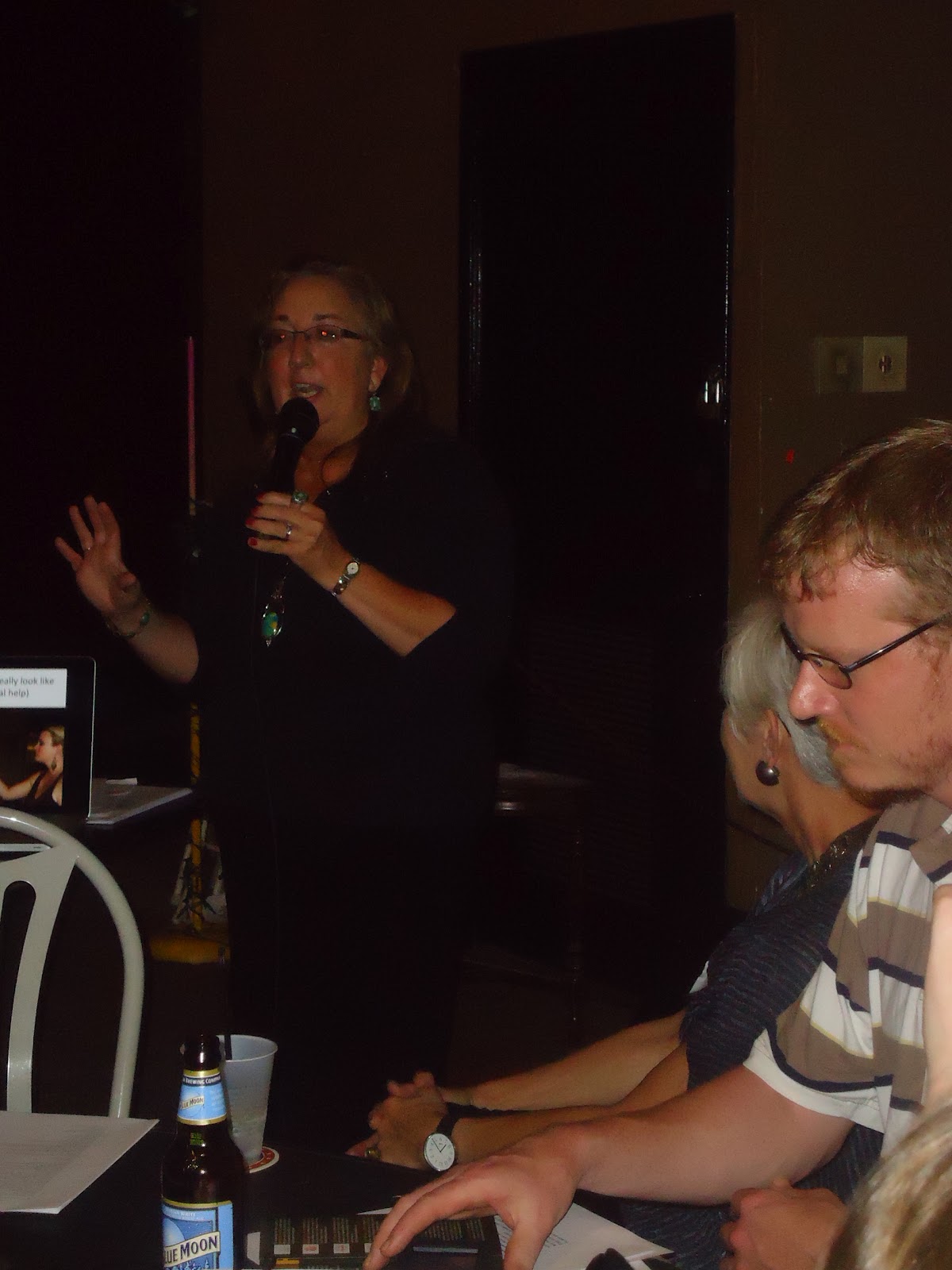
The importance of being able to relate well to others was just one of the many tips Dorman-Hickson offered Tuesday evening during her presentation “A Ghost Story: My Life as a Co-Writer and Print/Web Writer.”
At this event, hosted by See Jane Write Birmingham, Dorman-Hickson discussed ghostwriting and collaborative writing, freelance writing, and personal branding to a crowd of 30 local writers.


Is co-writing for you?

The primary difference between ghostwriting and co-writing is with ghostwriting you won’t receive any credit for helping with the book. Your name won’t appear on the cover and you’ll even have to sign a contract stating that you won’t reveal your connection to the project. With co-writing, you will receive credit, but it’s still important to check your ego at the door. As Dorman-Hickson explained when recounting her experience with Herring, the person you’re working with gets the final word when making creative decisions.

With co-writing, you may be paid a flat or hourly rate. Dorman-Hickson said that on average the hourly rate is about $73 per hour. Flat rates run the gamut and can range from $6,000 to $150,000, but typically average at about $22,000.

To be a successful co-writer you need much more than good writing skills. This is a job that will call for you to be an editor and to manage people.

If you think co-writing is for you, one of the best ways to land co-writing gigs is by networking with other co-writers. You should also place a profile on PublishersMarketplace.com, Dorman-Hickson recommended. And don’t be afraid to approach prominent people and offer to help them tell their story.

The Truth About Freelancing


During her talk, Dorman-Hickson was very honest about the realities of freelancing. It is nearly impossible to survive as a full-time freelancer these days because most publications pay writers such meager fees. But don’t be discouraged. Learn to maximize each assignment you get and also think outside the box. Market your writing services to companies that haven’t been hit as hard by the economic downturn.


Buidling Your Brand
Dorman-Hickson also discussed personal branding because whether you want to admit it or not, to be a successful writer, you have to build a successful brand for yourself. This may sound like a daunting task, but it can be easier than you think. A few things you’ll need: business cards, a website and/or blog, and an e-newsletter.
You can even use your email signature and your voicemail greeting as promotion tools.
Give presentations to writing groups and book clubs.
And work on your elevator speech. Be sure that you can give a short, yet captivating description of what you do at a moment’s notice.
One of the things from Dorman-Hickson’s talk that stood out to me most is the idea that one of the best ways to help your writing career is to help other writers with their careers. That’s exactly what I strive to do with See Jane Write. It’s nice to know I’m on the right track.
 

Scenes from the See Jane Write August Event


Cross-posted at WriteousBabe.com.


Let’s Help Our Fellow Writers

I’m sure for many of you your hearts are heavy this week as you learned about the hundreds of Alabama journalists who recently lost their jobs due to cuts made by Advance Publications. 

Birmingham-based advertising agency Luckie & Co. has launched a project called #ALNewsJobs, a grassroots effort to find and share good job openings for all those affected by this week’s layoffs. You can follow the group @ALNewsJobs on Twitter and by liking ALNewsJobs on Facebook. You can read this post to learn more about why they started the group. 

I would like to make a plea that you share information that you have about any job openings that could be a good fit for these talented journalists who are now available for hire. Please send that information to #ALNewsJobs and please also share he information with me (via email or by leaving a comment on this post) so I can announce these opportunities to the members of See Jane Write who may be in search of their next step. 

Please keep our fellow scribes in your thoughts. 

See Jane Freelance

Last night my organization See Jane Write Birmingham hosted its third educational event, Freelancing 101. This panel discussion featured writers and editors of top local publications and drew about 50 attendees. Complete with free refreshments and time to network with other local writers, it was a great way to spend a Tuesday night. (But I might be a bit biased.)

Here is a taste of the writing wisdom the panelists shared with us.
Carla Jean Whitley is managing editor of Birmingham Magazine and she loves coffee. I mean, she really loves coffee, and that’s actually good news for you. One of the pearls of wisdom Carla Jean shared at Tuesday’s panel discussion is the value of building relationships with editors, and you can start simply by inviting them out for coffee. Over a cup of jo you can pick their brains about their publications and their freelancing needs.
This is not to take the place of doing your homework, first. Before attempting to freelance for a publication it’s important that you be familiar it. “Read more than one issue,” Carla Jean suggests. All panelists agreed that you must get to know a publication’s style and have a sense of its audience to successfully pitch story ideas.
And speaking of story ideas, Carla Jean says that one of the best ways to come up with stories to pitch is to simply follow your curiosity. “If you’re interested someone else may be too,” she said. “Keep your eyes open.”
Glenny Brock is editor-in-chief of Weld, a newsweekly that she and three partners founded last year. Even though Glenny couldn’t “give a hoot about hunting and fishing,” some of the best writing advice she ever received was from a man who specialized in this very topic. (Fun fact: Glenny’s first freelance piece was published in a magazine called Varmint Masters.) From this writer/editor, Glenny learned how important it is for a writer to see stories everywhere. “He never did an interview for just one story,” she said. Glenny believes that by asking the right questions, a good reporter can retrieve information and details for five stories in one interview. “Use every part of the animal,” she said, no pun intended. So if you’re doing a profile on a fisherman also find out some of his favorite fishing spots, the best places to buy fishing gear, etc. These can be the starts of more stories.
As for pitching your ideas Glenny said it’s important to be as specific as possible. So don’t email her saying you want to write a story about running. Instead consider pitching a story about a running group or new marathon in town. Your pitch will also be more appealing, she said, if you already have a few sources in mind for the story.  
When Chianti Cleggett talks about writing her face lights up and she sounds as joyful as a girl with a new crush. But this isn’t puppy love. Chianti has had a long-time love affair with the written word.  Chianti has been featured in various publications including The Birmingham Times, Birmingham Magazine, and Essence.com. Many of her writing opportunities have come from others being award of her love of writing. All her friends and family know it’s her passion so they’re constantly sending her leads.
Panelist Kate Agliata said Tuesday night that, “Good writers are constantly reading,” and Chianti is a prime example of that. You’ll often find her in a book store delving into magazines. This is a great way to generate story ideas. Chianit and Glenny recommend looking for ways to localize national stories or taking a local story and finding a national angle.
Afraid of pitching to national publications? Don’t be. Chianti says it never hurts to just go for it. “Take a stab in the dark,” she said. “What do you have to lose?”
One of the best pieces of advice Kate Agliata ever received was: “Write what you know.” Kate has been doing just that working as a writer and editor for MyGreenBirmingham.com, Birmingham’s online green living resource. Her work has also been published by several nationally recognized websites including HGTVPro, HGTVRemodels, and Got2begreen, one of Time magazine’s 2009 best rated websites.
If you’re thinking, “Well, I don’t feel like a know much,” you need to change that ASAP, sister. Kate recommends really focusing on a few of your interests and developing an expertise in those areas. That doesn’t mean you know everything. In fact, you need to stay thirsty for more knowledge. If you read something and you have questions, seek out the answers, Kate said. Chances are you’ll stumble upon a story idea in the process.
All of this may be a lot to take in, but if you remember nothing else, take this to heart: keep writing. All four panelists agreed that the best way to see your byline in your favorite publications and the only way to realize that dream of being a successful full-time freelancer (successful meaning you can pay your bills without eating Ramen noodles for dinner every night) is to write as much as you can. Get your name out there even if it means writing for a tiny community paper or even a newsletter for a local organization. And, yes, even if it means occasionally writing for free.
But in the midst of the hustle don’t lose your love for language. Chianti, for example, sets aside time once a week to simply write for pleasure.
And Kate’s advice is this: “Write every day, even if only for 5 minutes.”

Are you kicking yourself for missing this awesome event? I have great news! Local photographer and educator Lynsey Weatherspoon recorded audio of the event. You can check it out here.  


Why You Need to Freelance

magazine shrink ray?
Image Via Creative Commons


I was in the 5th grade when I announced to my parents, teachers, and friends that “when I grow up I’m going to be an author.” I remember thinking that title sounded so important, so regal. 


Two decades later I have yet to publish or even write a book. Sometimes I get a bit disheartened by this but I’m encouraged when I remember that I am still a writer nonetheless. I’ve written for magazines, webzines, and newspapers and I blog like crazy. I know that all the smaller projects and assignments I’m doing are good practice. And practice makes perfect, right? 


In fact, writer and blogging superstar Jeff Goins says that the best way to start a writing career is to write for magazines. Goins writes:

It doesn’t matter if you’re a future novelist, nonfiction author, or journalist. Writing short-form pieces prepares you for long-form. This is a great alternative to endlessly working on multiple drafts of your book and letting it sit in a drawer for years.”


He goes on to say that writing features for magazines, websites, and other publications teaches you to be humble about your work (yes, even you need an editor) and teaches you how to meet deadlines. And on top of all that, writing for magazines usually pays.


If you’re wondering how to get started, Goins recommends writing reviews, doing interviews on your blog, and working to gigs with online publications. Read more of Goins’ suggestions here


And you have the opportunity to learn even more on breaking into the world of freelancing. On Tuesday, May 15, See Jane Write will present Freelancing 101. This event is a panel discussion featuring successful freelance writers and editors of local publications. Click here for more information and to register for this free event.

Happy writing and I hope to see you May 15!